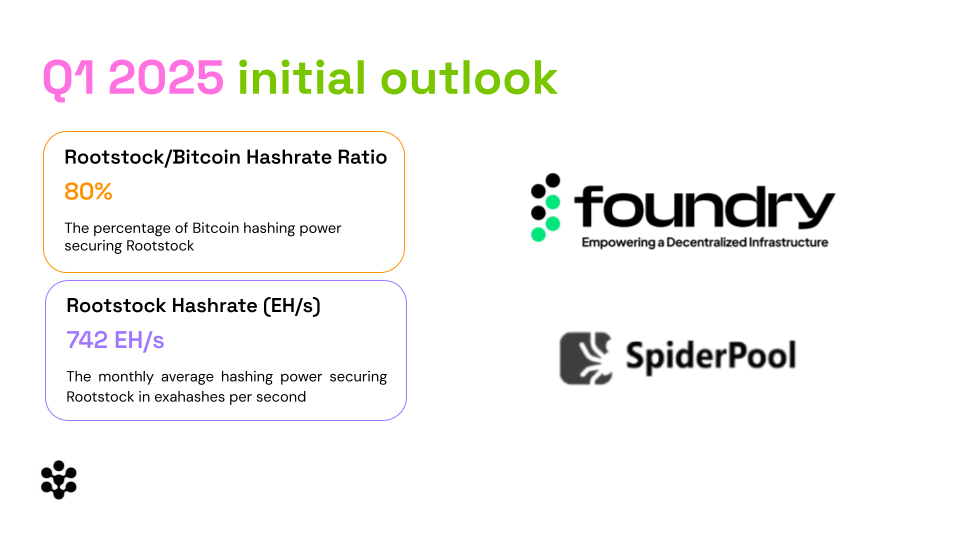
Big news for the home of DeFi on Bitcoin – Foundry, the world’s largest Bitcoin mining pool, is now merge mining Rootstock, the longest-standing and leading Bitcoin layer. This means over 740 exahashes per second now secure Rootstock, around 80% of Bitcoin’s total mining power today.
To put that in perspective, Rootstock is now secured by more hash power than the entire Bitcoin network was back in October 2024, reaffirming its position as the most secure, unstoppable, uncensorable, and immutable smart contract platform in the world.
The Rootstock community welcomes Foundry to the family where it joins the world’s most innovative Bitcoin miners and pools, all dedicated to taking Bitcoin beyond a store of value and transforming it into critical financial infrastructure for the future of humanity.
Other Bitcoin miners and mining pools merge mining Rootstock include Braiins, Luxor, Binance Pool, Ant Pool and F2Pool.
Merge Mining at a Glance
As a Bitcoin sidechain, Rootstock inherits Bitcoin’s security while maintaining its own decentralized blockchain. This is achieved through a process known as merge mining. What this means is miners securing the Bitcoin network can simultaneously secure Rootstock without using extra energy or hardware.
Merge mining secures both the Rootstock blockchain and Rootstock’s native Bitcoin bridge, the POWpeg. This makes Rootstock resistant to attacks while ensuring the POWpeg Bridge remains trust-minimized, censorship-resistant, and protected from manipulation by requiring peg transactions to be validated within Bitcoin’s merge-mined consensus.
Bitcoin mining pools choosing to merge mine Rootstock earn 79% of all transaction fees which are paid in rBTC. This means Rootstock directly contributes to Bitcoin’s economic model while reinforcing security. It’s a win-win for miners, Bitcoiners, and DeFi users.
Why does this matter for DeFi users?
Since day one, Rootstock has been laser-focused on security and decentralization. The network has had 0 hacks, 100% uptime since 2018, and now it’s harder than ever to attack.
- More hash power = set-in-stone, unalterable transactions.
- More mining power = stronger defense against 51% attacks.
All of this makes Rootstock the leading DeFi layer for Bitcoin, the most secure way to borrow, lend, and stake BTC while benefiting from Bitcoin’s PoW security.
Why are mining pools choosing to merge mine Rootstock?
With block rewards being slashed during every halving event, smart miners are stacking new revenue streams. Merge mining Rootstock means extra BTC rewards (Paid in rBTC on Rootstock) for free with no extra energy consumption or no extra hardware spend.
By merge mining Rootstock, Bitcoin miners are boosting Bitcoin’s utility by providing security to smart contracts, lending, and staking on Rootstock. In turn, this brings more activity to the Bitcoin network which helps drive a growing demand for Bitcoin.
Proof of Work: The Best Security Model
Unlike Proof-of-Stake chains where power concentrates in a few hands, Rootstock sticks with Proof of Work; the security model that makes Bitcoin untouchable.
This means:
- No central control: Security isn’t based on who holds the most tokens.
- Censorship resistance: No one can stop transactions or rewrite history.
- Open to everyone: Miners compete based on computational effort, not wealth.
Bitcoin Mining 2.0
With Bitcoin’s block rewards shrinking every halving, miners need to stay ahead of the curve. The simplest way is merge mining.
Rootstock offers them a new revenue stream while securing Bitcoin’s future, at no extra cost.
The result?
- Bitcoin’s security stays strong,
- Bitcoin miners stay profitable,
- and you get a safer, more powerful way to put your Bitcoin to work.
Are you a solo miner or a mining pool? Start merge mining Rootstock today